The Fourth of July I Chose My Daughter Over My Brother
My name is Gwen Delgado. I’m thirty-eight, and I work as an insurance adjuster in Springfield, Missouri. Every Fourth of July, my family gathers at my parents’ vacation house on the Lake of the Ozarks. Usually, it’s a weekend of barbecues, swimming, fireworks, and relatives catching up over cold drinks. That year, it nearly became the worst day of my life.
My younger brother, Rhett, was thirty-four and had always been our parents’ favorite. No matter how irresponsible he was, they found a way to excuse it. He’d already been arrested twice for driving under the influence, and both times my parents called it an unfortunate mistake.
“He’s going through a difficult period,” my mother would say.
But Rhett’s “difficult period” had lasted more than a decade. Whenever I raised concerns, my parents accused me of being judgmental.
That summer, I brought my seven-year-old daughter, Winnie, to the lake. She loved swimming, but she wasn’t strong enough for deep, unpredictable water. I insisted she wear a bright orange life jacket near the dock. My mother thought I was ridiculous.
“Gwen, she’s seven, not two,” she complained. “You can’t wrap her in bubble wrap forever.”
I ignored her. Before becoming a mother, I’d competed in distance swimming at the University of Missouri and spent six summers teaching lifeguard training. I knew that even a child who could swim in a pool might struggle in a lake with boat wakes, currents, and changing conditions. So I taught Winnie one rule:
“If you ever end up in deep water, try not to panic. Find something that floats, hold on tightly, and call for help. Mommy will come.”
She would repeat it back with a serious little face: “Find something that floats. Hold on. Mommy will come.”
I never imagined how badly she would need that lesson.
That afternoon, the family was gathered near the dock. Music played from the patio speakers, food was grilling, and relatives sat under umbrellas. Winnie was nearby in her pink swimsuit and orange life jacket. I stepped inside for sunscreen. I was gone about four minutes.
When I came back, the dock looked strangely empty. I scanned the chairs, the steps, the water. Then I noticed Rhett’s jet ski was missing.
“Where’s Winnie?” I asked.
My mother barely looked up from her drink. “Oh, Rhett took her for a little ride. She wanted to go.”
My stomach tightened. “What?”
“Relax, Gwen. She’s having fun.”
“Mom, Rhett has been drinking since lunchtime!”
My father waved me off. “He knows this lake better than anyone. Stop worrying.”
I looked out across the water. Far away, I spotted the jet ski moving much too fast. Rhett was weaving through boat wakes, cutting sharply across the lake. Then, in seconds, the jet ski hit a large wave, its front end bounced upward, and I saw a small figure in a pink swimsuit fly off the back.
My daughter disappeared into the water.
I waited for Rhett to turn around. He didn’t. The jet ski kept speeding away.
“WINNIE!”
My scream made people on neighboring docks turn. My father grabbed my shoulder. “Calm down! Rhett will go back for her.”
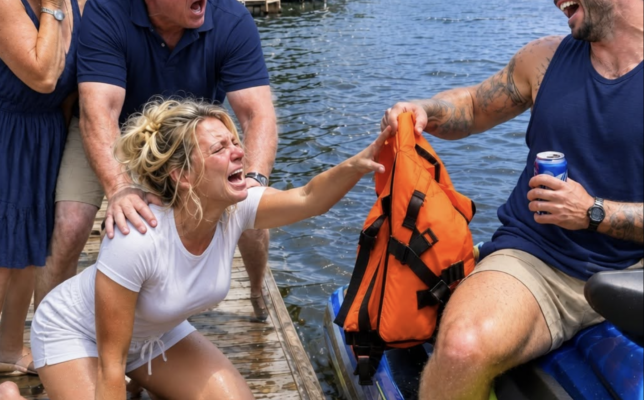
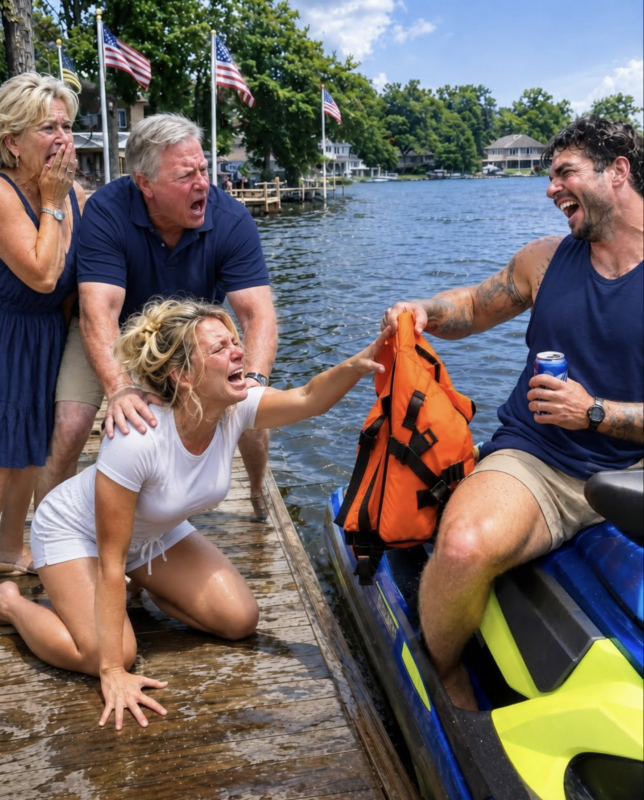
But Rhett didn’t return to where she’d fallen. He made a wide turn and headed straight for our dock. When he arrived, he climbed off laughing, as if nothing had happened. In his hand was Winnie’s bright orange life jacket.
My whole body went cold. “Rhett, why are you holding her life jacket?”
He shrugged. “She said it was uncomfortable. I told her she could just hold on to me.”
“She fell off the jet ski! Where is she?”
He blinked at me. “She’s fine. She knows how to swim.”
“WHERE DID SHE FALL?”
He gestured vaguely toward the middle of the lake. Before I could say anything else, my father stepped between us.
“Gwen, listen carefully. Don’t call the police.”
I stared at him. “What?”
“Your brother already has two drunk-driving convictions. Another incident could send him to prison.”
For a moment, I couldn’t process it. My daughter was missing in deep water, and my father was worried about Rhett’s record.
“Dad, MY CHILD IS STILL OUT THERE!”
My mother approached, irritated. “Don’t make everything worse, Gwen. Rhett’s had a terrible year already.”
Something inside me changed. I was done arguing. There was no time.
I pulled off my sandals, grabbed Winnie’s life jacket from Rhett, and handed my phone to my sixteen-year-old nephew, Sam.
“Call 911,” I told him. “Tell them a seven-year-old is missing in the lake. Tell them she fell from a jet ski without a life jacket. And tell them the driver has been drinking.”
My father shouted behind me. “Gwen, don’t you dare involve the police!”
I didn’t turn around. I ran to the edge of the dock and jumped.
The water was colder than I expected. I surfaced, took a breath, and began swimming toward the place where I’d seen Winnie fall. It was hundreds of yards away. Every stroke felt like a race against time. My arms pushed through the choppy water while my eyes searched for any sign of her—a small head, a raised hand, anything.
Behind me, people shouted from nearby boats. I kept swimming. I had trained in water for years. I had taught students how to stay calm in emergencies. But none of that prepared me for the terror of searching for my own child.
When I reached the area, I stopped and looked around. Nothing. Only waves and distant engines.
“WINNIE! BABY, WHERE ARE YOU?”
Then something small caught my eye. Pink. I reached for it, and my heart sank. It was Winnie’s hair tie—the little pink elastic with a plastic strawberry I’d used that morning.
For one terrible moment, I thought I’d arrived too late. But panic wouldn’t help her. I forced myself to think. I looked at the wind and the movement of the waves, then searched again.
“Winnie! It’s Mommy! If you can hear me, shout!”
Silence. Then, somewhere to my left, I heard a faint sound.
“…Mommy?”
I spun around. “WINNIE?”
“Mommy!”
I swam harder than I’d ever swum. Then I saw her: a small dark head barely visible above the waves, two little arms wrapped tightly around something yellow. As I got closer, I realized it was a floating seat cushion, probably lost from someone’s boat. Winnie had one knee hooked around it. Her lips were pale blue, her teeth chattering.
But she was alive.
I reached her and pulled her into my arms. “Baby! Oh, sweetheart!”
She started crying. “Mommy, I found something that floats. I held on, just like you told me.”
I couldn’t stop my tears. “You did everything right, Winnie. Everything.”
I helped her into the orange life jacket and secured it. Her small fingers clung to my neck.
“I called Uncle Rhett,” she whispered. “But he didn’t come back.”
My heart broke again. “I know, sweetheart. I’m here now.”
She buried her face against my shoulder. “I thought you wouldn’t find me.”
I kissed her wet hair. “I’ll always come for you, baby.”
A few moments later, a pontoon boat approached. A man in a baseball cap leaned over the side. “Ma’am! We’re here to help!”
He and his wife helped us aboard. The woman wrapped Winnie in towels and a warm blanket. The man said he had already contacted emergency services. Within minutes, the marine patrol arrived.
The man was Dale Pruitt, a retired firefighter. His wife stayed beside Winnie while we waited. A female marine patrol deputy checked Winnie and then looked at me.
“She’s cold and frightened, but she’s conscious and responding. We’re getting her medical attention immediately.”
I nodded, holding Winnie tightly.
The deputy spoke gently. “Ma’am, dispatch received a report that the person operating the jet ski had been drinking. Is that correct?”
“Yes.”
“Who was driving?”
“My brother.”
“Is he still at the dock?”
“As far as I know.”
She spoke into her radio, then asked me to explain what happened. I told her everything—how I’d gone inside for sunscreen, how Rhett took Winnie without asking, how I watched her fall, how he returned holding the life jacket instead of my daughter, and how my parents tried to stop me from calling for help.
The deputy listened carefully and wrote down my statement.
By the time we reached the hospital, I was shaking uncontrollably. Winnie needed observation because she’d been exposed to cold water and had inhaled some water. But she was alive. She was talking. And she refused to let go of my hand.
Later that evening, Sam appeared in the hospital hallway. He looked pale and exhausted.
“Aunt Gwen,” he whispered, “I’m sorry.”
I pulled him into a hug. “Sorry for what?”
“I saw Uncle Rhett drinking. I saw him take Winnie. I should’ve stopped him.”
I placed my hands on his shoulders. “Sam, you did exactly what I needed. You called for help.”
He started crying. “Grandpa kept telling me to hang up. He said I was destroying the family.”
Anger rose in me again. “Your grandfather was wrong.”
I held him until he stopped trembling, then returned to Winnie’s room.
Near midnight, she looked up from her hospital bed. “Mommy?”
“Yes, baby?”
“Is Uncle Rhett in trouble?”
I hesitated. “Yes, sweetheart.”
Her little face fell. “Because of me?”
I squeezed her hand. “No, Winnie. Because of the choices he made.”
She thought about that, then whispered something that nearly made me cry again. “I remembered our rule. I found something that floated.”
I kissed her forehead. “And that’s why you’re here with me.”
Rhett was arrested that evening. According to the investigation, his blood alcohol concentration was 0.19. Authorities also received witness statements about his reckless behavior on the water. He faced several charges, including boating while intoxicated, reckless operation, and child endangerment. Because of his previous convictions, the possible consequences were serious.
My parents immediately blamed me. My mother called repeatedly—first shouting, then crying. Eventually, she left a message that made me feel physically sick: “Gwen, he’s your brother. You’ve destroyed his future over one mistake.”
One mistake. That’s what she called nearly losing my seven-year-old daughter.
I didn’t answer. My father called two days later.
“Gwen, I need you to speak with the prosecutor.”
“About what?”
“Ask them to be lenient with Rhett.”
I couldn’t believe him. “Dad, he left my daughter alone in deep water.”
“But she’s okay now.”
“Because she remembered what I taught her. Because strangers helped us. Because we got lucky.”
My father sighed. “Rhett is still your brother.”
I closed my eyes. “And Winnie is still your granddaughter.”
He said nothing. Then I reminded him of the words I would never forget. “When she was missing, you told me not to call the police.”
“I was worried about Rhett.”
“I know, Dad. That’s exactly the problem.”
I ended the call. For the first time in my life, I didn’t feel guilty for standing up to my parents.
The court hearing took place in September. Rhett arrived in a gray suit, looking thinner and more subdued than I’d ever seen him. His attorney explained that he struggled with alcohol dependency and needed serious treatment. I agreed that he needed help, but I also believed what he’d done had to carry consequences.
When I testified, I described the entire afternoon—how briefly I’d left Winnie, how Rhett took her onto the lake, how I watched her fall, how he returned without her, and how I found her clinging to a floating cushion with blue lips. I told the court about my parents’ attempts to prevent an emergency call.
Then the judge asked me, “Ms. Delgado, what outcome are you hoping for?”
I took a moment. “I want my brother to receive genuine treatment for his drinking problem. I want him to understand how close he came to killing my daughter. And I want measures in place to protect other children from the same danger.” My voice shook. “I don’t want revenge. I want accountability.”
Rhett received a three-year prison sentence, followed by five years of probation and mandatory treatment. He was also prohibited from operating watercraft. My mother sobbed in the courtroom. My father wouldn’t look at me.
Afterward, Rhett asked to speak with me. With a court officer nearby, I agreed.
His eyes were red. “Gwen, I don’t remember her falling. I remember taking her out. I remember the jet ski. But I don’t remember her going into the water.”
I nodded.
He swallowed. “I would never intentionally hurt Winnie.”
I looked directly at him. “But you did hurt her.”
His eyes filled with tears. “Is she okay?”
“She’s recovering. But sometimes she still asks why you didn’t come back.”
He lowered his head and cried. Part of me wanted to comfort him. He was still my little brother. But I couldn’t keep protecting him from the consequences of his actions.
“I hope you recover, Rhett,” I said. “I genuinely do. But I won’t keep rescuing you from your decisions.”
The incident changed Winnie. For weeks, she was frightened of water. Even bath time became difficult. She had nightmares about being alone in the lake. I arranged for her to see a child therapist. We worked patiently to help her feel safe again. She practiced breathing exercises and drew pictures of the lake. Slowly, the fear began to ease.
One afternoon, months later, she looked up at me from the kitchen table. “Mommy, I want to learn how to swim really far.”
I smiled gently. “Why, sweetheart?”
“So if someone else falls into the water, maybe I can help them.”
I had to look away for a moment. “Okay, baby. We’ll work on becoming a stronger swimmer.”
She returned to swimming lessons at an indoor pool. At first, she was hesitant, but little by little her confidence returned. By spring, she could swim a full length of the pool. By summer, she could tread water for several minutes. And whenever we visited a lake, she still wore her orange life jacket. I never had to remind her. She understood why it mattered.
At one family gathering, my mother made another thoughtless comment. “Winnie, don’t you think you’re getting a little old for that life jacket?”
My daughter looked directly at her grandmother. “No, Grandma. It keeps me safe.”
The table went quiet. For once, my mother didn’t argue. She looked down at her plate and said softly, “You’re right, sweetheart. I’m sorry.”
It was the first genuine apology I’d ever heard from her.
My father took longer. Several months passed before he came to my house alone. When I opened the door, he stood on the porch holding his hat.
“Gwen,” he said quietly, “I owe you an apology.”
I waited.
“I was wrong that day.” His voice trembled. “I put Rhett’s future ahead of Winnie’s life. I told you not to call for help when my granddaughter was in danger.” Tears filled his eyes. “I’ve replayed that moment every night.”
I said nothing. He continued. “For years, your mother and I convinced ourselves Rhett was just going through a bad period. We kept excusing his behavior instead of helping him face it. And I nearly lost my granddaughter because of it.”
Then he asked whether he could apologize to Winnie. I wasn’t ready. “Not yet, Dad. She needs time.”
He nodded. “I understand.”
But he didn’t disappear. He started visiting every Sunday. Sometimes he brought pastries. Sometimes he simply sat on the porch swing. He didn’t demand forgiveness. He didn’t pressure me. He just kept showing up.
Eventually, one chilly afternoon, Winnie walked outside and sat beside him. “Hi, Grandpa.”
His face softened. “Hello, sweetheart.”
She studied him. “Mommy says you apologized.”
He nodded. “I did. I was wrong.”
Winnie leaned against his arm. “Okay.”
It wasn’t a dramatic reunion. But it was a beginning.
On the second anniversary of that terrible Fourth of July, Winnie and I visited a different lake—smaller and quieter. We rented a little rowboat and spent the afternoon in the sunshine. Winnie wore her bright orange life jacket. And in her hair was the same pink strawberry hair tie I’d found floating in the water two years earlier.
I’d kept it safely in a drawer. After months of therapy, she’d asked if she could wear it again.
Now she sat beside me, smiling as the boat gently rocked. We watched the sun sink toward the horizon. After a while, she looked up.
“Mommy?”
“Yes, sweetheart?”
“Do you remember our rule?”
I smiled. “Of course I do.”
She repeated it slowly. “Find something that floats. Hold on. Mommy will come.”
I felt tears gathering. “I remember every word.”
She reached for my hand. “You really came, Mommy. Even though I was far away.”
I squeezed her fingers. “I’ll always do everything I can to come for you, sweetheart.”
For a while, we sat quietly together. I thought about the moment she disappeared beneath the waves—the pink hair tie, the yellow cushion, the terror of believing I might never hold her again. And I thought about the choice I’d made that afternoon.
My parents wanted me to protect my brother. They wanted me to stay quiet. They wanted me to pretend his reckless behavior was another harmless mistake. But I refused.
Because being a good daughter or sister should never mean putting a child’s safety at risk.
My family accused me of destroying my brother’s life by calling the police. But the truth is that his own actions nearly destroyed my daughter’s life.
I still hope Rhett receives the help he needs. I hope he learns from what happened. Perhaps one day our family will find a healthier way forward.
But I will never regret calling for help. I will never apologize for protecting my daughter. And I will never forget that a seven-year-old girl survived because she remembered one simple lesson:
Find something that floats. Hold on. Help will come.
That little girl was braver than any of us realized. And every time I see her smiling beside the water in her bright orange life jacket, I remember how close I came to losing everything.
**THE END**